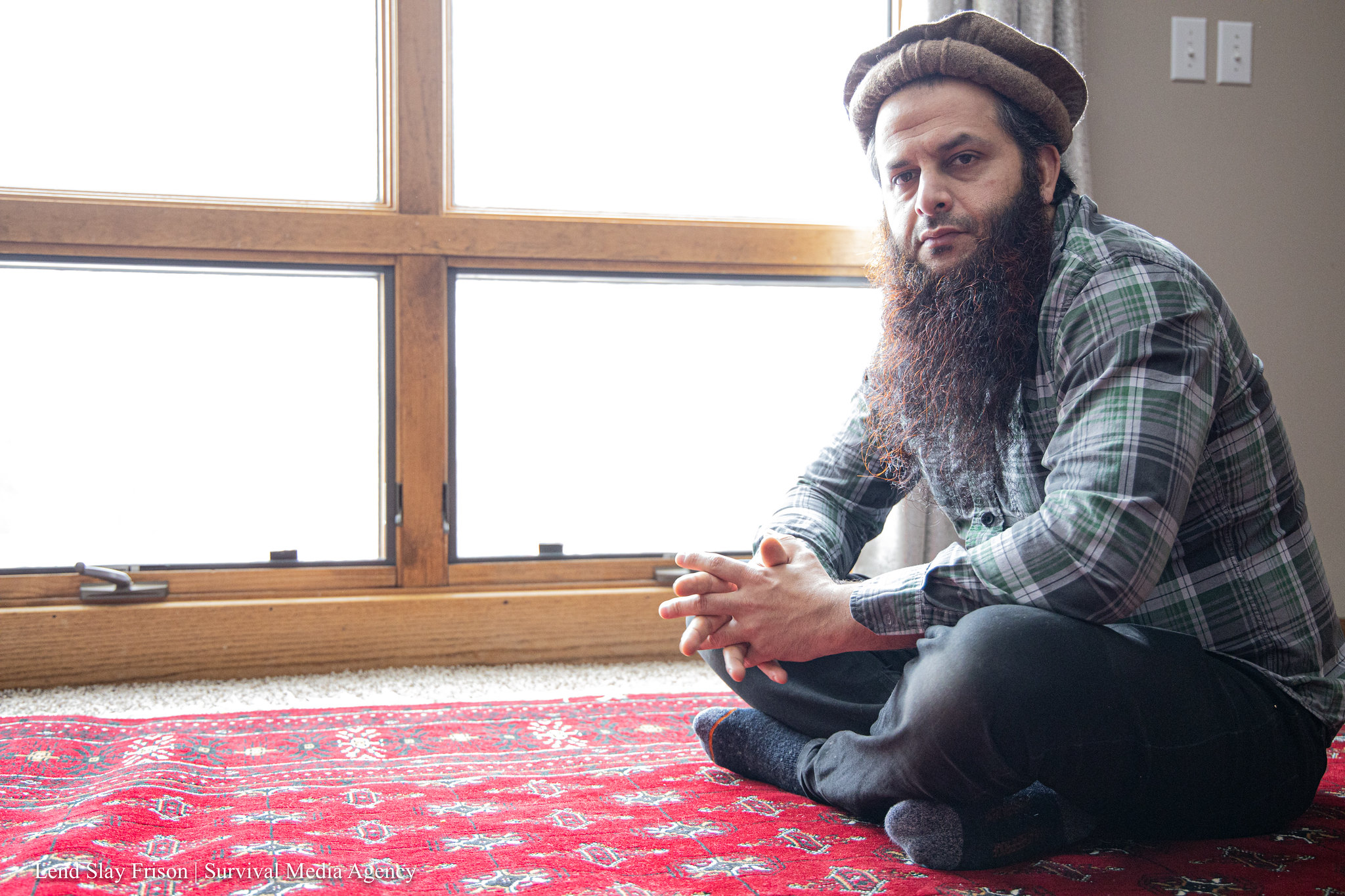
Photo of plaintiff Naveed Shinwari taken by Lend Frison
Naveed Shinwari is a lawful permanent resident who has lived in the United States since 1998, when he was just 14 years old. He currently lives in Omaha, Nebraska with his wife and three daughters. Naveed is a plaintiff in Tanzin v. Tanvir, a federal lawsuit challenging the FBI's abuse of the No-Fly List as a tool to coerce American Muslims into spying on their religious communities.
"Words can't explain the suffering of my family, the worry and tears of my mother. The years I couldn't see my wife because I was stuck in this open prison and couldn't fly."
In February 2012, Naveed and his mother were travelling from Afghanistan back to the United States, where he was living. While in transit through Dubai, they were prevented from boarding their flight and Naveed was told that he would need to contact the U.S. consulate in Dubai before he could fly. The next day, Naveed went to the consulate and met with two FBI Special Agents who took him into an interrogation room and questioned him for more than three hours. They asked him questions about whether he had visited any training camps in Afghanistan and whether he was associated with any "bad guys," and questions about the mosque Naveed attended in the U.S. and his religious activities. They used threatening language, and at times he felt coerced to speak. At several points, the FBI asked him to take a lie detector test, but Naveed declined because he believed he was answering all of their questions truthfully. Two days later the agents said he could return to the U.S. if he bought a new plane ticket on a U.S.-based airline, which he did.
When Naveed and his mother landed in Virginia for their layover, federal agents searched his bags and belongings. Two FBI agents escorted him to a room and interrogated him for two hours. He answered all of their questions truthfully, just as he did in Dubai, but was told that he would be visited by FBI agents when he arrived home in Omaha.
"I felt like I was in shackles, imprisoned, uncertain of what would happen next."
In mid-March 2012, FBI agents appeared at Naveed's home, questioning him again about the same topics he had discussed in prior interrogations. This time, the agents told Naveed that they knew he was unemployed and that they were willing to pay him to be an informant on his own religious community. The FBI's focus on Naveed had nothing to do with any ongoing criminal investigation or activity connected to him or specific individuals in his community. Naveed declined to work as an informant because of religious and moral objections. He believed that if he became an informant he would have to engage with his peers in a deceptive manner, monitor, and entrap innocent people, and that those actions would interfere with the relationships and trust he had developed with those community members. He didn't want to put himself or his community at risk, or be associated with a government or agency that persecuted its own people.
Shortly after this conversation, Naveed attempted to board a flight from Omaha to Orlando, where he had obtained temporary employment. He was denied a boarding pass at the airport. Police officers approached him at the ticket counter, told him he was on the No-Fly List, and then escorted him out of the airport. FBI agents showed up the next day at his house unannounced and, for the second time, asked Naveed if he would become an informant, offering him financial compensation and other assistance if he agreed to work with the FBI. Naveed declined again, knowing that refusing to do so would likely mean the FBI would keep him on the No-Fly List to pressure him.
"They would scare me psychologically. [They] mentally abused me. I went into a major depression and suffered from anxiety and panic attacks. I didn't want to go outside of the house, I couldn't keep my job, and I had to use all my credit cards to pay the mortgage and countless bills. The debt piled up."
Because of his placement on the List, Naveed couldn't take the job in Orlando. For years, he couldn't easily visit his father in Virginia, or see his wife and family in Afghanistan. He suffered serious economic and emotional distress and became reluctant to attend religious services. Due to the lack of transparency around the No-Fly List, the FBI has enormous unchecked power to abuse the List and use it as an extrajudicial tool to intimidate and coerce individuals like Naveed.
Eventually, Naveed found lawyers to represent him and joined other American Muslims in filing a federal lawsuit challenging the FBI's use of the No-Fly List to coerce them into spying on their religious communities. It was only when CUNY CLEAR, the Center for Constitutional Rights, and the law firm of Debevoise & Plimpton filed the case that the U.S. government confirmed that Naveed was no longer on the No-Fly List. Naveed and the other plaintiffs continued their lawsuit and are trying to hold government officials accountable. His case is currently before the Supreme Court.
When asked why his continued pursuit of justice is important to him, Naveed explained that he wanted to use his lawsuit as an opportunity to educate and organize against federal repression. He said: "Everyone knows how the world treats Muslims. No lawsuit has to tell them that. The government has an unlimited amount of resources at its disposal. We will resist and speak out."
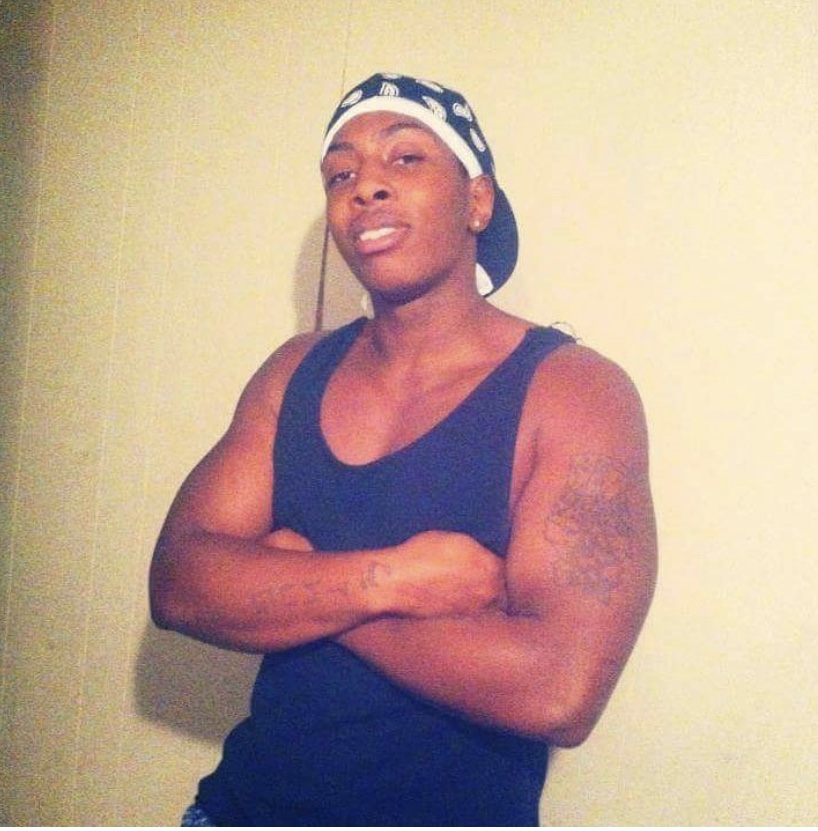
Christopher Rogers is 29 years old and is currently detained in the East Baton Rouge Parish Prison. He has already served more time than his charges carry, but he remains imprisoned because of the COVID-19 pandemic.
In mid-April, Mr. Rogers reported symptoms to a nurse, but the medical staff didn't do anything because they said that no one else had tested positive for COVID-19 in his area. He was left for days with a bad headache and body aches, and he submitted a medical request to get his temperature checked. When Mr. Rogers had a temperature, he was moved to lockdown in line B3 of the jail before his test results came back positive for COVID-19 a few days later.
"B3 is in part of the old building in the prison that was closed before the coronavirus hit because it was filled with mold and rats. I was never allowed to leave the B3 line. I couldn't go outside, get any rec time, or get my own food. We had no way to talk to anyone else in the prison, except for the other guys on B3. We were basically just left back there. There were some windows on B3, but we could barely see out of them. They were on a catwalk outside of our cells. We didn't get to see much of the outside world on B3."
Mr. Rogers reports extremely unsanitary conditions in B3. The guards never clean the halls, and only sometimes bring cleaning supplies effective against the virus for the men to clean their own cells. The showers, which all the men in his line had to share, were filthy and had only cold water. There was mold on the shower mat and the shower itself was rusted.
Mr. Rogers's family put money in his commissary account so he could purchase personal hygiene supplies and food, but he was not able to receive items in lockdown. He and the other men isolated there didn't have access to a TV, and the guards didn't provide them with any information about what was going on in the world, or how to protect themselves from coronavirus. Their primary source of information came from family calls.
Mr. Rogers said that it was stressful to be in B3 because the men were bored, isolated, and didn't know what was happening. They were also surrounded by older people in bad conditions. "One man was really sick. We would bring him water when we could, but it was depressing and stressful to watch him struggle. I have been diagnosed with depression and anxiety, and being on B3 was making me more depressed and stressed."
Mr. Rogers was constantly afraid that he would get sick again because he continued to be held with people who were ill. He wrote to the medical unit about the fact that he was not given medical care for non-coronavirus needs. They never responded to his requests: "I felt like I couldn't get the medical care I needed and that we were being left back there to see if we would die."
Mr. Rogers filed a grievance about the men not having access to disinfectant to clean their cells and common areas in lockdown. Subsequently, the deputy involved in the grievance confronted Mr. Rogers, questioned him aggressively about the grievance, and shoved him into the wall. Mr. Rogers never received an official response to his grievance.
On May 8, Mr. Rogers left lockdown and returned to his F5 line, where he says the conditions are not much better. The area is hot and dirty; it is impossible for the men to be six feet apart from each other at all times; the eating area is covered with food particles and doesn't get cleaned regularly; there are many rats, and he has to sleep with his commissary items in bed so the rats don't eat them; and there is so much dirt on the windows that he and his other linemates can't even see out of them. Mr. Rogers also reports that one man who was COVID-19 positive was transferred out of lockdown and back to his line.
The guards did not permit Mr. Rogers to attend his court date on May 13, where he would have pled to time served, and so he remains detained. When he is released, he plans to quarantine with friends until his test results come back negative. Then he will move home with his mother and family members who rely on him to provide financial support. "I know they really need me out there."
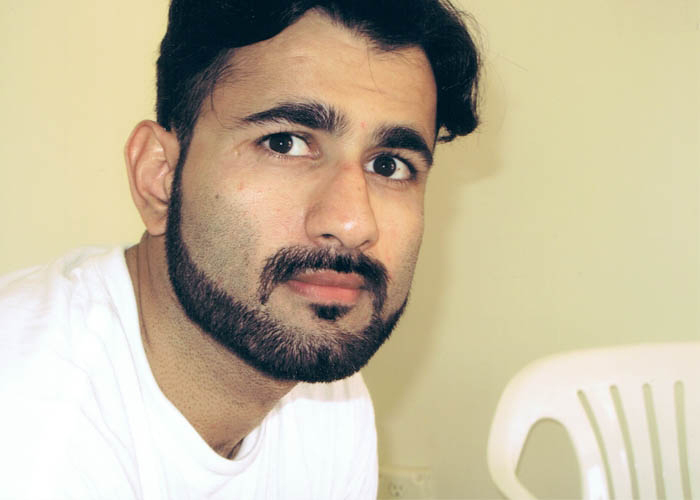
Majid Khan was sent to Guantánamo Bay in September 2006, at the age of 26. A citizen of Pakistan, he has long had political asylum status in the United States and other substantial ties to this country. He grew up outside of Baltimore, Maryland, graduated from Owings Mills High School, and lived and worked in the area. He is married and has a young daughter he has never met. Several of his other family members are U.S. citizens and still live near Baltimore.
In March 2003, Khan was captured, forcibly disappeared, and tortured by U.S. officials at overseas “black sites” operated by the CIA. His torture is described at length in the Senate Select Committee on Intelligence report on the CIA’s post-9/11 detention and interrogation program, key findings of which were released on December 9, 2014. Khan’s own account of his torture remains classified.
Notes of some of Khan’s personal recollections of his experience in secret detention were declassified by the government in May 2015, but other details of his torture remain classified. On June 2, 2015, Reuters published unclassified information detailing the CIA’s torture of Khan. In June 2016, in response to a FOIA lawsuit, the government made public a declassified version of Khan’s 2007 CSRT transcript, which contains more information about his time in custody.
On Wednesday, February 3rd, join Communities United for Police Reform, the Center for Constitutional Rights, and the New York Civil Liberties Union's Teen Activist Project for a conversation...
[caption align="right"] Speakers discuss Death by Incarceration at " Brick by Brick: A community forum on ending Death By Incarceration in Pennsylvania" [/caption] On January 26, Abolitionist Law...
On January 27, 2021, the International Federation for Human Rights (FIDH) and over 60 member organizations (including the Center for Constitutional Rights) released a coalition letter calling on the...
To honor Black history is to celebrate Black futures and the radical imaginings of our ancestors. Generations of Black freedom fighters have put forward liberatory political, social, and economic...
To honor Black history is to celebrate Black futures and the radical imaginings of our ancestors. Generations of Black freedom fighters have put forward liberatory political, social, and economic...
Black History Month 2021: A Legacy of Irresistable Black Futures [caption align="right"] [/caption] We are launching our celebration of Black History Month today and will update you with events and...
In our weekly call to action, we will highlight different partners and organizations who are doing movement work today to create a better tomorrow. We invite you all to continue to educate yourselves...