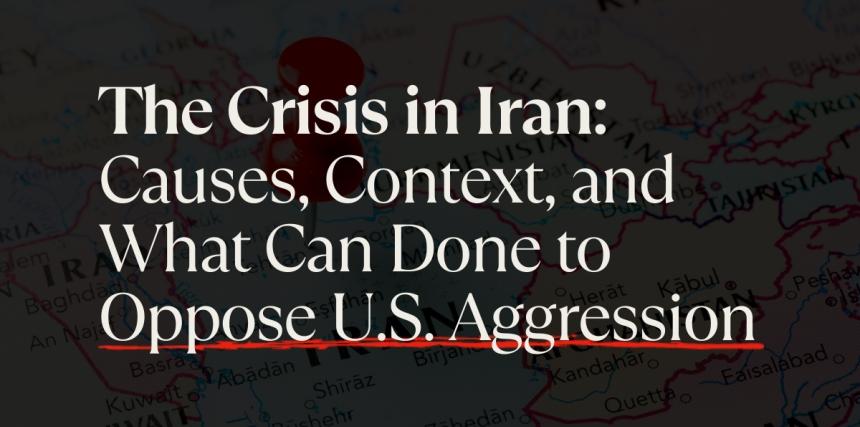
President Trump said last week that “Iran is running out of time” to negotiate a deal on its nuclear program as he continued to build up U.S. forces in the region. The options he is considering include raids by U.S. forces.
If he launches another illegal attack on Iran, it will be sold as “defense,” “deterrence,” or “support for democracy.” That script is familiar: it’s the same one used to rationalize drone strikes, occupations, proxy wars, sanctions regimes, covert operations, and bombings that always kill civilians without producing any of its promised benefits.
But what is happening now is not an isolated crisis. It’s the movement of an imperial system that has lost legitimacy, lost stability, and lost the ability to govern through anything except violence and coercion.
The problem extends far beyond the strike itself. The danger is what it could unleash: a surge in repression in Iran, a rapid chain of escalation, retaliatory attacks, regional destabilization, and the further collapse of the tattered remains of global constraints on state violence.
What is happening in Iran?
The ongoing protests in Iran, especially among the merchant class and small business networks, are rooted in interlocking economic and political crises that have been dragging on for years, now sharpened into emergency. Rapid currency devaluation has caused wages to plummet and savings to evaporate. The costs of basic necessities including food, medicine, fuel, and other goods have become prohibitively unaffordable for many.
U.S. sanctions have played a critical role in Iran’s economic collapse. Sanctions are often described as “targeted pressure” campaigns, but in practice they are designed to suffocate an entire economy: to choke access to currency, banking systems, trade, investment, and supply chains. They restrict medicines, distort markets, and create conditions where corruption and black-market opportunism flourish. Sanctions have hollowed out Iran’s middle class, helping to reduce the GDP per capita from $8,000 in 2012 to $5,000 in 2024.
The U.S. points to the sanctions-caused suffering as evidence that Iran is “unstable” and therefore must be further punished. The protests raise many important grievances facing the Iranian people, but they are not a justification for intervention. They are evidence of intervention already taking place: sanctions as slow violence. In this context, protests are a response to immiseration, not an invitation for more foreign intervention.
The collapse of international law and global norms
The increased U.S. aggression toward Iran arrives at a time when the idea of an enforceable international order is disintegrating. For decades, the U.S. promoted a “rules-based international order,” itself designed around U.S. imperial interests, selectively enforced, and used to discipline weaker states. But even at its most hypocritical, this framework still created some constraints.
Israel’s genocide in Gaza, and the U.S. willingness to enable it has drastically accelerated the breakdown. The message to the world is not only that mass slaughter is tolerated, but that law itself is negotiable if the perpetrator is aligned with U.S. power. When international law is treated as little more than a minor inconvenience, it stops being a deterrent; it becomes an aesthetic. The U.S. rewrites rules to suit the moment. This signals to other dominant powers that it is free to inflict similar suffering within their “spheres of influence,” opening the floodgates to assassinations, kidnappings, plunder, seizures of leaders, regime change campaigns, and “counterterror” operations that treat entire populations as collateral. Violence is increasingly the only currency of international order.
Oil
An important factor linking the US attack on Venezuela to its posture toward Iran is oil. Each country holds critical reserves and occupies strategic positions in the global economy, especially in an era where great powers are hoarding supply chains, preparing for future shocks, and treating energy as a weapon. Oil is never just oil. It’s logistics, industry, political leverage, military projection, and the ability to survive disruptions.
Trump has largely dispensed with the kind of professed concern for human rights that U.S. presidents have historically deployed to sell U.S. wars. After he invaded Venezuela, he scarcely even bothered pretending that he cared about democracy. What the United States wants there and everywhere is a compliant government that it can pressure into predictable alignment: on pricing, access, contracts, and geopolitical posture.
Venezuela’s nationalization and decolonization of oil resources represented one of the clearest disruptions of corporate energy rule in the hemisphere. Iran’s independence represents a similar barrier in West Asia (as it did in 1953, when Iran’s nationalization of the oil industry led to the U.S coup). These projects, though deeply flawed, contested, and full of contradiction, are nevertheless unacceptable to empire because they insist that the wealth under a country’s soil belongs to the people living on it, not foreign shareholders.
The impact of an US attack on Iranians: the trap of foreign entanglement
Far from helping Iranian citizens, a U.S. attack is likely to intensify their oppression. Foreign entanglement gives authorities in Iran a script: “This isn’t real dissent; it’s a foreign conspiracy.” That script becomes the pretext for crackdowns, arrests, surveillance, censorship, disappearances. This is why U.S. officials’ grandstanding about “supporting the Iranian people” is not solidarity. It is strategic sabotage dressed in moral language. Pompeo openly signaling Mossad involvement doesn’t help protesters; it endangers them. This is especially true in the context of decades of US intervention in Iran, including the bombing of Iranian infrastructure just last year. Iranians understand that US interference has never been about supporting their self-determination; it is a projection of Israeli and US hegemonic ambitions.
Claims of concern for Iranians’ right to protest also ring hollow when the U.S. is violently repressing protest at home, murdering and jailing demonstrators, conducting door-to-door raids, and openly adopting fascistic rhetoric. Solidarity applied only to official enemies is propaganda.
What We Can Do
While deterring war is always a daunting task, Trump is an increasingly unpopular and isolated president. Indeed, it’s evident that his redoubled imperialism is, in part, an attempt to divert attention away from his political woes at home. Yet there is little popular support for his wars, and he has barely even tried to manufacture consent. All of which make his aggressive stance toward Iran vulnerable to political pushback.
Some in Congress are working to assert their constitutional authority to declare war. War Powers resolutions are limited, but they are nonetheless a chokepoint that forces public votes and can restrict unchecked executive war-making. We should press Congress to pass new War Powers Resolutions to constrain the Trump administration’s reckless warmongering.
We should, more broadly, demand that Congress block new war funding. Trump’s obscene ambitions for a 1.5 trillion dollar military budget would spawn endless war, repression, and destabilization, at home and abroad. This is the moment to reverse the tide.
So mobilize and organize, call your Congresspeople, show up, take to the streets. Make it clear to Trump, Congress and the world: Trump’s lawlessness and brutality will be resisted on every front, from Minnesota to the Middle East.
Samer Araabi is the Associate Director of Political Education and Research at the Center for Constitutional Rights.
