

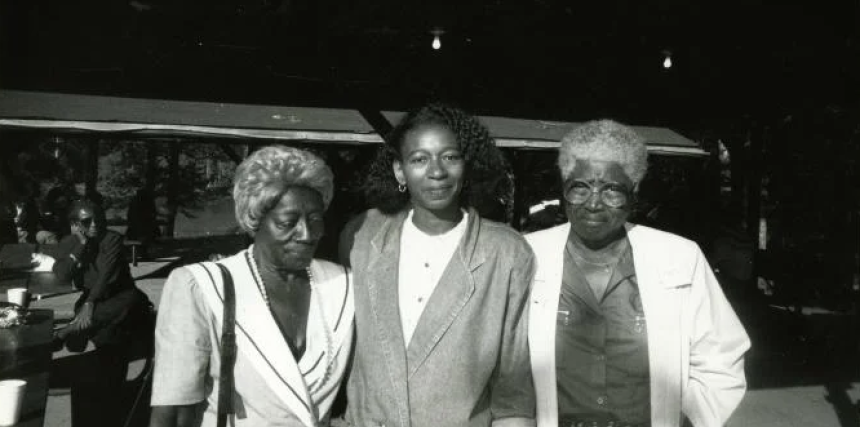
Original members Annie Devine (left) and Victoria Gray Adams (right) of the Mississippi Freedom Democratic Party with former Center for Constitutional Rights attorney Judge Margaret Carey-McCray (center) in Holmes Country, Mississippi. CREDIT: Photographer unknown, 1998
In 1964, Fannie Lou Hamer helped found the Mississippi Freedom Democratic Party (MFDP) as an alternative to the state’s white supremacist Democratic Party. During the presidential primary, the MFDP hosted its own state convention and sent its own delegates to the national convention in Atlantic City. Although Democratic party leaders refused to seat them, Hamer’s riveting televised testimony – in which she recounted the time that police officers jailed her and forced Black men to beat her nearly to death – helped build support for the Voting Rights Act.
Among those standing with Hamer during this time were four radical lawyers – Morton Stavis, Arthur Kinoy, William Kunstler, and Ben Smith – who had heeded the call of Freedom Summer and traveled to Mississippi. Kinoy and Stavis were on Hamer’s legal team when she brought a successful lawsuit against the state for denying her and other Black people the right to vote. All four lawyers were forever changed by the experience of working with and learning from Hamer and her fellow activists. It revealed to them the need for a legal organization to support the Black Freedom struggle and other people’s movements.
The idea for Center for Constitutional Rights was thus birthed sixty years ago in the Mississippi Delta.
Over the decades, the organization has done some of its most groundbreaking work in the South. Too extensive to detail in this space, that work includes a series of cases defending the rights of Stokely Carmichael and other Student Nonviolent Coordinating Committee members, a landmark free speech victory at the Supreme Court in a case brought by a civil rights group, a successful effort to hold the Klan accountable for its violence, and a challenge to the Bush administration’s repression of political protests.
We also helped secure several major victories on voting rights – victories now under attack in the wake of the gutting of the Voting Rights Act. We represented Black activists who challenged illegal redistricting plans, and filed lawsuits that enabled Black candidates to run for and stay in office. Throughout the 80s and 90s, we successfully challenged at-large-elections in Chattanooga and other cities as a violation of the Voting Rights Act.
A few years ago – recognizing both the danger of resurgent white supremacy and the opportunities created by the ever-dynamic efforts of Southern activists and organizers – we deepened our commitment to the region via CCR South. With increased resources and more staff based in the South, we’ve worked to build new relationships and nurture existing ones, partnering with activists, community-based organizations, and liberatory movements from Atlanta to Jackson to New Orleans. We’re perpetually in awe of our partners’ resilience and creativity as they fight for their civil and human rights, material needs, and cultural self-determination in the face of a rising tide of racism, corporate capture, transphobia, misogynoir, and xenophobia.
It’s difficult work, to say the least. Racism and other structural hatreds run deep in legal systems, state legislatures, and governors’ offices across the old Confederacy. Knowing they have a friend in the White House and believing history has taken a turn (backward) in their favor, MAGA politicians and the corporations they serve have felt even more emboldened than usual to exploit vulnerable communities. They’re trying to take everything they can. At stake, often, is the health, heritage, and land of people who descend from people who were enslaved.
Yet even here, in the epicenter of mounting American fascism, our partners have shown us that progress is possible. We’ve taken on landmark cases designed to support the systemic, sustainable changes that they envision. In the heart of Cancer Alley, our clients – Inclusive Louisiana, Mount Triumph Baptist Church – have joined with RISE St. James to challenge St. James Parish’s unconstitutional practice of steering toxic industry into Black neighborhoods, seeking a historic moratorium on petrochemical plants in the majority-Black 4th and 5th Districts.
At a time when the rights of trans people are under attack on numerous fronts, especially in the South, we’re continuing our front-line gender-justice work. In Georgia, following an earlier lawsuit we brought on behalf of an incarcerated trans woman and activist against the Georgia Department of Corrections, a judge blocked a law banning medically necessary, evidence-based gender dysphoria treatment in prison.
And as local governments, in collaboration with rapacious corporations, seek to place factories on and near former plantations in the South, infringing on the rights of people to access and care for the sacred sites of their families and communities, the burial grounds of enslaved people are a frequent area of struggle. To halt such industrial expansion into sacred land, we’ve filed suit in Louisiana on behalf of Inclusive Louisiana and The Descendants Project. They’re seeking access to a cemetery located on the former Buena Vista plantation, which contains the bodies of named as well as unidentified people who died while enslaved on the land. We have also helped a historic Black community in South Carolina regain access to their community cemetery after it was blocked off by private landowners.
That’s just a portion of the work we’re doing in the South. We’ve also represented courageous people incarcerated in Alabama who brought the first-of-its kind state court lawsuit challenging slavery and involuntary servitude in prison; fought for water justice on behalf of partner organizations and local community in Jackson; worked to free politically targeted people caged in immigration prisons in Mississippi and Georgia; partnerned with a Black elected official and exoneree’s challenge against the State of Louisiana’s unconstitutional effort to remove him from office; and sought transparency related to the torture and abuse of suspects by the Sheriff’s Office in Rankin County Mississippi.
As we celebrate the Center for Constitutional Rights’ 60th Anniversary this year amid growing authoritarianism in the South and beyond, we know we must remain steadfast in our effort to build and strengthen our relationships with frontline activists and social movements as they fight for racial, economic, environmental, and queer justice.
Here in the South, struggle doesn’t daunt us. We live and work in the lingering light of people like Fannie Lou Hamer, the granddaughter of enslaved people and the twentieth child of sharecroppers, who risked her life challenging white supremacy. As our friend and Voice of the Experienced policy analyst, Ronald Marshall says, “To struggle is to never face defeat, only progress and eventual victory. So, keep the struggle alive and healthy in your heart.”
Emily Early is the Associate Director of CCR South
