

Guerra. Invasión. Golpe.
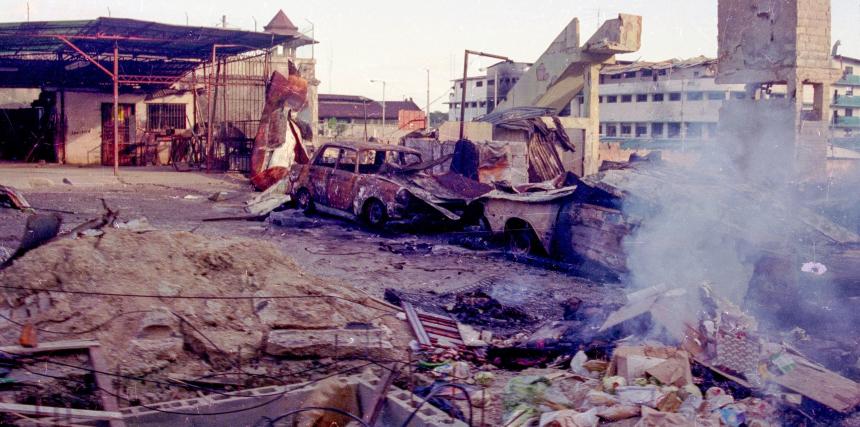
These were the words being whispered by the adults around me in the days after the United States invaded Panamá in 1989. I was about six years old. My family had emigrated to Washington Heights in the early 80s, a primarily Spanish-speaking immigrant neighborhood in New York City. I certainly didn’t understand geopolitics, but I understood fear. I understood the tears. I remember adults purchasing as many calling cards as they could, trying to reach family back home. I saw my parents cry for the first time, whispering that something bad had happened, something that would change everything.
I heard the name Noriega over and over again. It was the first time I realized these words meant loss. And I would later learn that one of the fractures of that invasion was personal: I wouldn’t be able to see my favorite uncle, Carlos, because he had refused to murder his own people in the “golpe” — the coup — that followed. He had joined the U.S. military at 19, a naturalized citizen trying to give his family safety and opportunity. But he drew a line at killing his own people. For that, he was gone.
Like many immigrants, my parents saved every cent so that we could return to Panamá most summers so that we could stay connected to our culture, to our people. But they waited three years after the U.S. invasion before they felt safe enough to take us back. I was older then, old enough to hear the stories, old enough to understand trauma.
The invasion, illegal under international law and waged in the name of so-called security, was a turning point in our lives. It struck fear and fury into Panamanians at home and abroad alike. We lost family and friends. Regarded as a success by the U.S. political establishment, the invasion killed hundreds of Panamanians, left thousands homeless, and devastated the economy.
And now, decades later, after yet another illegal U.S. intervention in Latin America, I am taken back to those whispers, those late-night phone calls, the anxious tension of a community waiting for word. On January 3, 2026, the United States launched a military escalation against Venezuela — an act that Center for Constitutional Rights has condemned as “blatantly unlawful aggression” born from a long legacy of military intervention and disregard for international law and the right to self-determination.
I couldn’t help but think about my own childhood fear and what it must feel like for Venezuelan families today. As I grew older, I began to learn about the violent, corrupt history of U.S. intervention throughout the Americas and around the world. From Panamá to Iraq, from covert operations to drone strikes, the logic of empire has spawned so much bloodshed in the name of “security” and “order.” What today’s actions in Venezuela make painfully clear is that this white supremacist, imperialist ideology has never been an anomaly — it is a through-line in U.S. policy that seeks to control resources, suppress sovereign movements, and enforce a global hierarchy of power.
And this imperialist maneuver comes on the heels of years of violence and threats of violence elsewhere, including a genocide in Gaza where respect for international law feels like a distant memory.
If there’s anything clearer now than ever before, it’s this: We have a responsibility to dismantle the U.S. imperialist machine, to challenge the endless wars, the occupations, and the interventions cloaked in the language of justice but rooted in domination. The irony and the tragedy of the United States violently violating human rights, international law, and its own Constitution to supposedly “bring justice” to primarily exploited countries is now painfully obvious.
But from that tragedy grows our purpose.
We will not be silent.
We will not stand by as the U.S. wages endless war.
We will not allow history to repeat itself unchallenged.
At the Center for Constitutional Rights, we stand in solidarity with international calls to mobilize against and resist U.S. imperialism abroad and the continued criminalization of dissent at home.
We know that resistance — rooted in solidarity, accountability, and justice — is the only path forward. It is the legacy we must build for future generations.
This is not just geopolitics.
This is personal.
And it is moral.
We will continue to fight in the courts, in the streets, and in the stories we tell, until war, injustice, and empire have no place in our world.
Sunyata Altenor is the Communications Director at the Center for Constitutional Rights
