
At a Glance
Date Filed:
Current Status
In October of 2020 the D.C. District Court granted Summary Judgment to Defendants, holding the Bureau of Prisons did not violate due process when it designated Kifah Jayyousi to the CMU. We appealed to the D.C. Circuit Court, and on February 25, 2022 they rejected our appeal.
Our Team:
- Rachel Meeropol
- Pardiss Kebriaei
Co-Counsel
Client(s)
Case Description
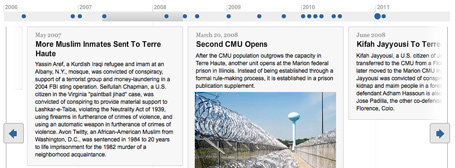
In 2006 and 2008, the federal Bureau of Prisons (BOP) secretively created two experimental “Communications Management Units” (CMUs) in Terre Haute, Indiana, and Marion, Illinois, designed to isolate certain prisoners from the rest of the prison population and the outside world. Prisoners in CMUs are banned from any physical contact with friends and family, and their access to phone calls and work and educational opportunities are extremely limited. CCR filed Aref v. Holder (now Aref v. Garland), challenging policies and practices at the CMUs, in the U.S District Court for the District of Columbia, on April 1, 2010. The case is part of CCR’s broader efforts to challenge mass incarceration, discrimination, and abusive prison policies.
The plaintiffs in Aref are low- or medium-security prisoners who were designated to the CMU despite their clean or near-spotless disciplinary histories. Not a single one has been disciplined for any communications-related infraction within the last decade, nor for any significant disciplinary offense. Though the creation of the CMUs marked a dramatic change in BOP policy, they were opened without the required public notice and opportunity to comment.
Discovery materials in Aref reveal that incomplete and inadequate procedures have been used to designate and retain prisoners at the CMUs. These procedures have been marked by missing paper trails and political and religious discrimination, amounting to a truly Kafkaesque form of imprisonment. For example, prisoners are not told why they have been transferred to a CMU until after they arrive. Even then, the reasons they are provided are frequently vague, inaccurate, and/or completely false, and they are given erroneous – and even impossible – instructions for earning their way out of a CMU. Policies governing the CMUs are often unclear and interpreted differently by different BOP decision-makers. In addition, 60 percent of CMU prisoners are Muslim, though Muslims comprise only 6 percent of the federal prisoner population.
Since the CMUs were created, the designation and review process has denied prisoners due process at every step. CCR’s lawsuit asserts that designation to a CMU involves serious deprivations and restrictions, and these units must be brought into line with constitutional requirements.